
A nine-week-old puppy may already know how to sit for a treat. He can come running when he hears his name, give a paw, and in a single evening work out how to open a badly closed door. Especially if he is an Australian Shepherd.
But none of these abilities tells you whether the puppy can wait calmly while his food is prepared. Whether he can fall asleep while the family is still moving about the house. Whether he can see a child without grabbing their trousers. Whether he understands that an open front door is not an invitation to run out.
Cues are only a small part of a dog’s life. Most of the raising happens in between them.
The puppy does not yet know your house rules
To a person it is obvious that a sofa is for lying on and that its corner is not a chew. That the dinner left on the kitchen table still belongs to a human. That nights are for sleeping and the neighbours should not be woken at five in the morning.
To a puppy none of this is obvious. He is not breaking the rules — he does not know them yet.
So the aim of the first months is not to teach ten cues as fast as possible. The aim is to create a life in which the behaviour you want is the puppy’s easiest choice. If you do not want him stealing socks, the socks have to be out of reach. If you do not want the puppy chasing a child, an adult has to supervise their interaction, choose a safe distance and stop the puppy getting over-excited. If the puppy cannot yet be calm in the whole house, he should not be allowed to roam the whole house.
There is no strictness here — this is simply where teaching begins.
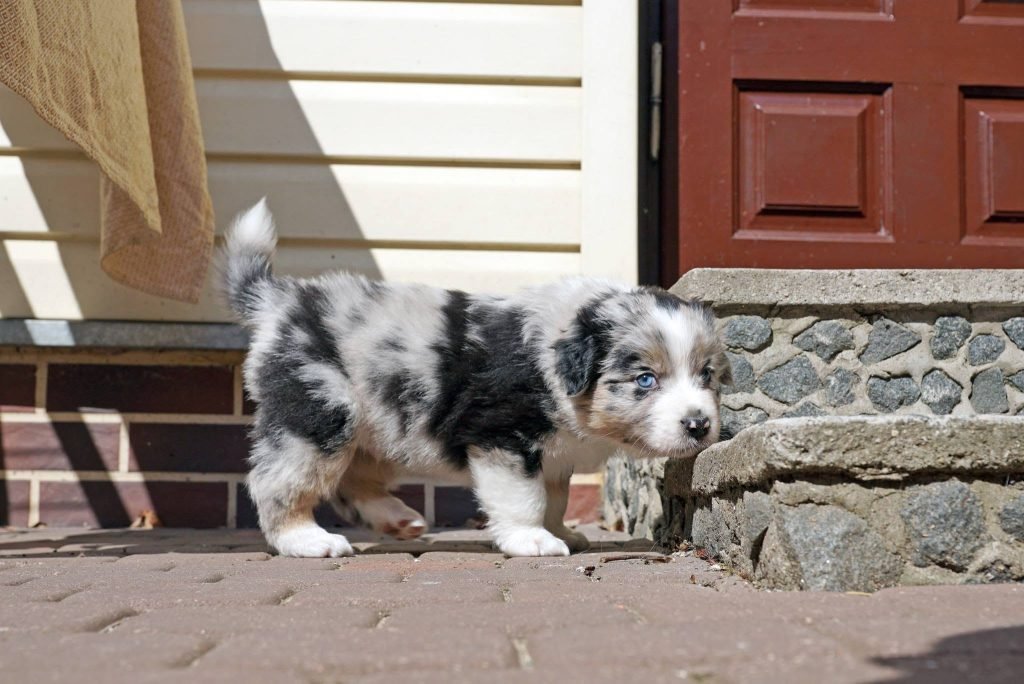
Freedom is not a measure of love
One of the most common mistakes in the first days is giving a puppy too much freedom out of good intentions. He gets access to every room, chooses where to fall asleep, follows people constantly and finds a new occupation every few minutes.
From the outside this looks like a curious puppy being introduced to his home. To his nervous system it can be an unbroken stream of stimulation with no chance to stop. And for you it is an environment in which it is impossible to notice every puddle, cable or scrap fallen from the table in time.
Freedom has to grow alongside ability. At first one safe room, a pen or a space beside you is enough. Later, once the puppy can stay clean, chooses appropriate chews and settles more easily, his world is widened.
This does not mean the puppy is being “controlled”. He is being protected from habits that would take a long time to change later.
Clear boundaries are not dominance
Older dog-rearing sources often talk about the “alpha” position or the need to show a dog who is boss. Modern behavioural knowledge lets us put it more precisely.
A puppy does not need a person who can physically overpower him. He needs an adult whose behaviour he can predict.
Such a person does not allow biting of hands, but nor do they punish the puppy for a natural need to bite — they offer a suitable chew and stop the game when teeth touch skin. They do not let the puppy jump on a child, but nor do they wait for conflict — they clip on a light lead in advance, increase the distance and reward the puppy for keeping all four paws on the ground. They do not shout about a puddle, because they understand that taking him out in time is still their responsibility.
The boundary is clear. Teaching it is calm.
What is repeated grows stronger
A puppy’s behaviour is shaped not by what you meant, but by what actually happened.
If a puppy barks and gets attention a few minutes later, the barking worked. If pulling on the lead gets him to every scent, pulling took him where he wanted to go. If stealing a slipper starts a merry chase with the whole family, the slipper has only become more valuable.
This does not mean you must rush to correct the dog himself after every mistake. Usually it is the situation that needs changing. Pick the slippers up. Approach the scent only once the lead is loose. Offer attention before the barking, while the puppy is lying calmly.
Good raising often looks utterly unimpressive. You notice the right moment and stop a problem from becoming a rehearsal.
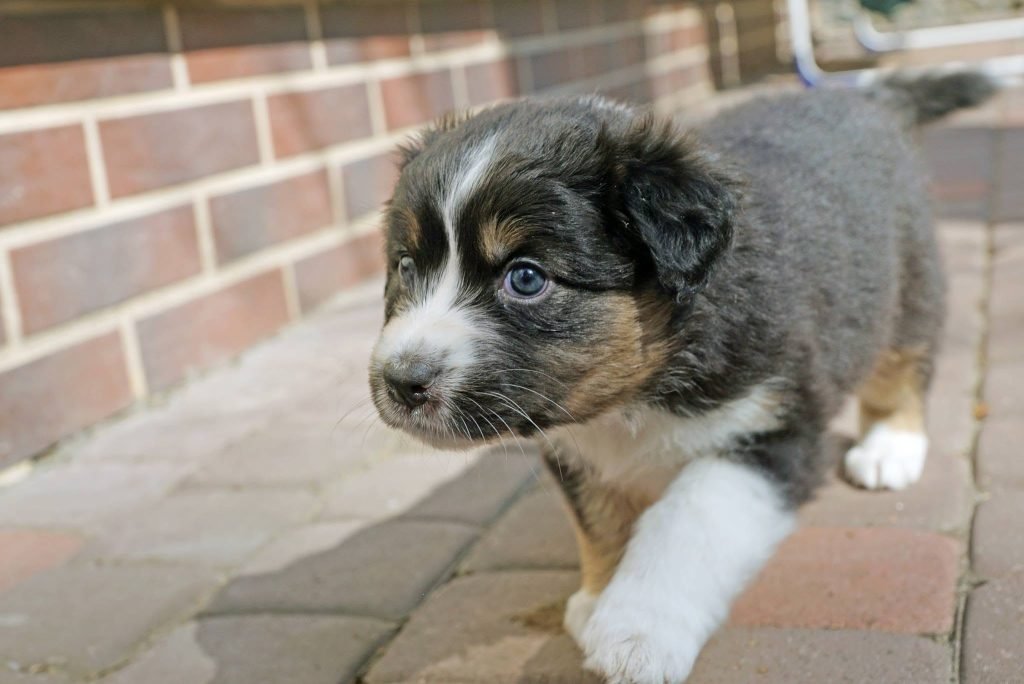
An Aussie must be taught not only to act, but also to stop
An Australian Shepherd spots patterns quickly, responds sensitively to movement and often wants to be involved in everything. So it is easy to fall into a trap with him: the more active the dog, the more activity he is offered; the more activity, the harder it is for him to rest; the harder it is to rest, the more active he seems.
Rest is not what is left over after the “real work”. The ability to settle is one of the most important skills a future family dog can have.
It starts with very simple things: a quiet corner, a predictable shape to the day, uninterrupted periods of sleep, and your own ability not to respond to every invitation to do something. Sometimes the best thing you can do for a clever puppy is not to invent another task, but to help him fall asleep.
Training has to fit real life
Raising a dog is a way of life, not a short intensive “sorting out” phase. A dog does not come back from school fixed for good. A trainer can show the direction, but everyday behaviour is still shaped at home.
So there is no point creating rules the family will not keep. If you do not want to demand a sit before every sip of water for the rest of your life, there is no need to start doing it merely to demonstrate control. Choose the boundaries that genuinely matter: safety at doors and in the street, respectful behaviour with children, calm at home, the ability to stay alone, being handled and groomed calmly, and a reliable bond with you.
A puppy does not need a perfect family. He needs a family that understands what it teaches him every day.
Read next: The first 72 hours: helping your puppy understand a new home