
A dog rarely opens a conversation with a growl. Even more rarely with a bite.
Usually he had already been speaking more quietly before that. Slowed his movement. Turned his head away. Closed a mouth that had been open. Licked his lips, though there was no food nearby. Tried to move away — and only when there was nowhere left to go did he choose a louder signal.
People often miss these moments. The growl seems sudden, because until then the conversation had no words.
One sign is not an answer
It is easy to find a list online: yawning means stress, a wagging tail means joy, flattened ears mean fear. A living dog does not fit that dictionary.
A dog may yawn because he is tired. He may lick his lips after food. He may wag his tail when excited, tense or even preparing for conflict. So we assess not one body part but the whole picture: weight distribution, muscle tension, the mouth, the eyes, the ears, the tail, the direction of movement and what has just happened.
A loose, easily moving body says something different from a stiff one. A dog approaching in a curve sends a different message from one walking straight, slowly and with a fixed stare. The same tail movement near a familiar person and near a guarded bowl can mean entirely different states.
Body language is not a collection of separate words. It is more like a sentence whose meaning changes with context.
Quiet requests for more distance
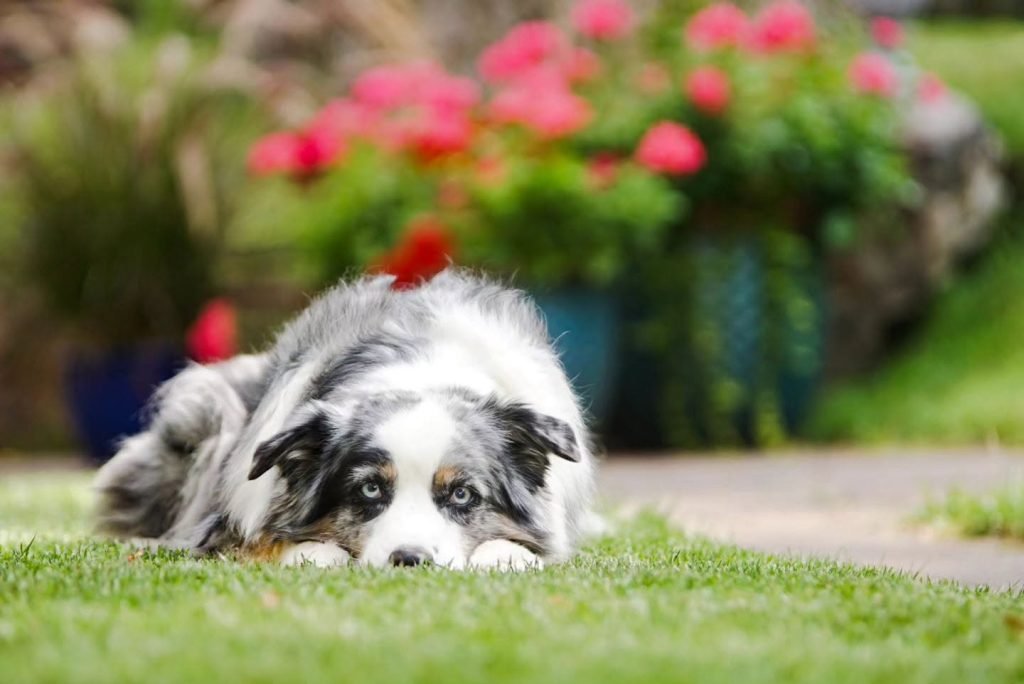
When a situation is uncomfortable, a dog usually tries first to soften it. He may turn his head away, avoid direct eye contact, slow down, crouch, lift a front paw, lick his lips, yawn, shake himself off, or start sniffing the ground as though he had suddenly found an extraordinarily important smell.
These signals do not always mean great fear. Sometimes they say only: “I need more time” or “Please, do not come straight at me.”
If a person stops, turns side-on or allows the dog to withdraw, he no longer needs to speak more loudly. If the hand still reaches over his head, a child hugs him and the lead prevents him leaving, you may see freezing, a hard stare, growling, bared teeth or a sudden snap.
So one of the most important lessons in body language is not the names of the signals. What matters more is learning to answer them.
Freezing — the moment you must not miss
Barking looks dramatic. Freezing is almost unnoticeable. Yet a suddenly motionless body can be one of the most important warnings.
A dog who was moving a second ago closes his mouth and freezes. His gaze hardens. His weight shifts forward or, on the contrary, he seems to shrink and prepare to retreat. That is not the moment to test “whether he would really bite” by leaning in further, touching him or taking an object away.
Stop the activity, increase the distance and consider the cause. If it happens repeatedly around food, toys, the bed, when the dog is touched or near children, you need a considered plan, not another attempt to prove that a person can do as they please.
Growling is not disobedience
Growling can be frightening, especially when a dog growls at a family member. The natural reaction is to forbid the sound. But punishing the signal does not necessarily remove its cause.
A dog can learn not to growl and still feel just as unsafe. Next time the intermediate warning will be shorter, or there will be none at all.
A growl is information: too close, too fast, it hurts, I am afraid, I do not want to lose this object, I have nowhere left to go. That does not mean we leave the situation uncontrolled. You end it safely and start addressing the cause — sometimes with a vet, sometimes with a qualified behaviourist.
The “guilty look” usually speaks about the present
You come home and find the bin tipped over. The dog lowers his head, turns away and quietly withdraws. It looks as though he understands exactly what he did.
Often the dog is responding not to a moral decision taken an hour ago, but to what he sees now: your frozen body, your changed voice, your direct stare and his previous experience of such situations. He is trying to reduce the tension.
People constantly project their own story onto a dog. But we should not conclude from this that the dog needs to be shown his place more firmly. It is far more useful to ask: what could the dog actually have learned from this moment, and how do we prevent the situation recurring?
Children should learn not to “not be afraid”, but to observe
A child can love a dog and still frighten him. A hug, a face at the muzzle, leaning on him, following him to his bed or taking a toy away can feel to a person like closeness. To the dog it can mean losing his space.
Teach children simple signs: the dog turned away — we stop; he moved off — we do not follow; he is sleeping or eating — we do not touch; he froze — we call an adult. But even a well-taught child is not a safety system. The responsibility for supervising the interaction stays with the adult.
How to start seeing more
Film short everyday situations and watch them back in slow motion. What did the dog do before he jumped? When did his mouth close? Did he approach directly or in a curve? When did the other dog turn away? Such a review often reveals signals we missed at the time.
Do not rush to diagnose every movement. Learning body language starts with description without interpretation: “the dog stopped chewing, raised his head and froze”, rather than “the dog decided to dominate”. Only then do we assess the situation and possible causes.
The sooner we hear the quiet signal, the less often the dog has to shout.
Read next: He knows the cue but still ignores it: training and behaviour are not the same