
A crate can be one of the most useful tools when raising a puppy. It helps him rest, travel safely, recover after procedures, manage the environment and learn to be clean indoors.
It can also become a place a dog fears, if the first introduction happens while someone is rushing out of the door: the puppy is pushed in, the door is shut and a long “let him cry it out” evening begins.
The point is not the crate itself, but what the dog experiences in it.
First choose the right place and size
The puppy must be able to stand up, turn around, lie down comfortably and stretch out in the crate. For a growing dog a larger crate with a divider you gradually move back is practical. Too small a space is not cosy. In too large a space some puppies, in the early stages of house-training, set up a separate sleeping corner and a separate toilet corner, so the size is worth adjusting — but not at the cost of the dog’s comfort.
Put the crate where the family spends time, but not in the very centre of the traffic. Avoid direct sun, draughts, radiators and places where children or another dog constantly come up to it. Part of the crate can be covered if that helps the puppy switch off, but good air circulation must remain.
Put in a non-slip, easily washable base. Soft bedding is fine if the puppy does not shred or eat it. Judge the need for water by how long he is shut in and by the temperature; for longer periods the safest option is a non-tip bowl fixed to the bars. When leaving the puppy unsupervised, remove any collar or harness that could catch on the bars. Toys and chews should be ones whose safety you have already checked for that particular dog.
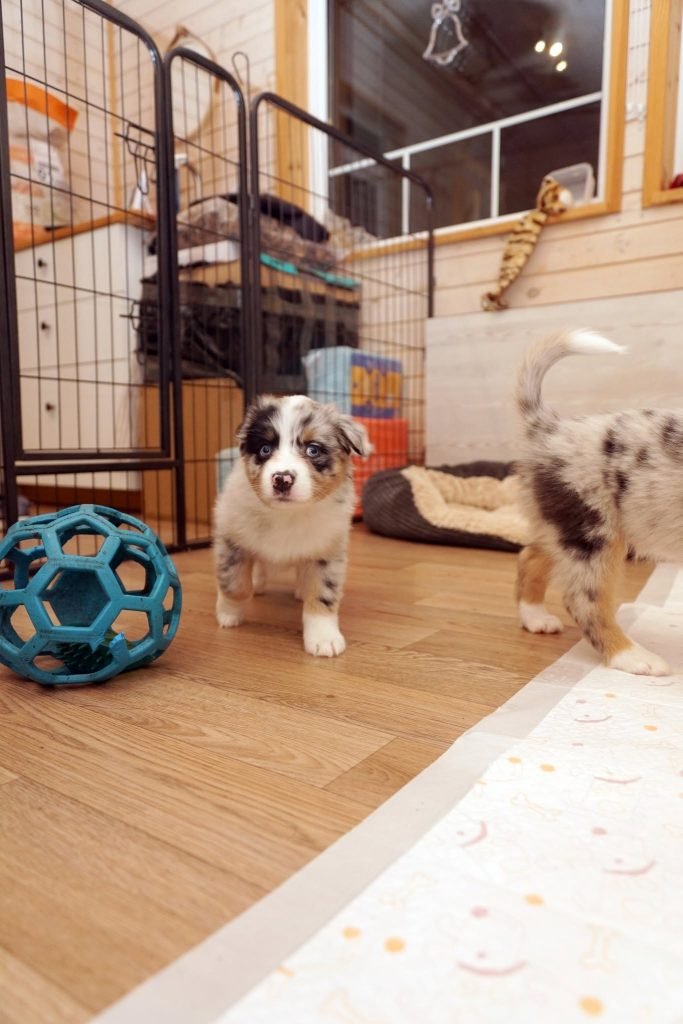
Step 1. The crate door means nothing
Begin the first introduction with the door open and, if possible, fixed, so that it cannot move unexpectedly. Toss a treat by the entrance. The next one — slightly further in. Let the puppy come and go.
Do not push him in with your hands and do not block the way back. At this stage the aim is not to stay in the crate as long as possible. The aim is to cross the threshold voluntarily, without tension.
Part of his food can be given in the crate. If the puppy is hesitant, the bowl stands by the entrance at first and later moves further in. If he runs in boldly, still do not rush to close the door the first time simply because the chance arose.
Step 2. The crate is worth staying in
When the puppy goes in by himself, place the reward between his front paws or at the back of the crate, rather than luring him straight back to your hand. Offer a safe chew. Sit down calmly nearby.
You can start adding a cue, for example “in you go”, but only say it before the puppy enters once you are almost certain he will. The cue must not become a word after which the dog braces for a battle with you.
Let him out before the puppy starts asking. Several short, successful sessions are worth more than one long one.
Step 3. The door closes for seconds
While the puppy is chewing or eating, calmly touch the door and move it back again. Later push it to, open it, reward. Then close it for one or two seconds and open it again while the puppy is still calm.
Lengthen the time unevenly: two seconds, five, three, eight. If every repetition only gets harder, the puppy starts waiting for the moment when it becomes too much.
Opening must be calm too. There is no need for an enthusiastic greeting or for turning the exit into a starting gun. If the puppy rushes at the door, you can wait a second for a pause in the movement and only then open it wider. But do not hold a full bladder hostage to a perfect “wait”.
Step 4. The person moves
When the puppy can spend a few minutes shut in calmly while you sit beside him, start moving around the room. Stand up and sit down. Take one step. Walk to the table and back. Disappear behind the door frame for a moment.
Come back before the anxiety starts. That way the puppy learns that a person moving does not mean being left, and that disappearing is not necessarily long.
If you only pick up your keys, put your shoes on or pull on a coat before leaving for a long time, these actions quickly become heralds of anxiety. Sometimes pick up the keys and put them back. Put your shoes on and drink a cup of tea. Everyday signals must not always predict the hardest task.
Step 5. Sleep comes to the crate
The easiest time to plan a first longer rest is when the puppy has relieved himself, has done something calm and is naturally drowsy. This does not mean the puppy should be worn out to the point of collapse.
Offer a chew, dim the light and stay nearby. One puppy will be helped by a partly covered crate, another by being able to see you. Watch the actual animal, not the theory.
In the first weeks the crate can stand beside the bed at night and in the main family space during the day. If you can, having two crates is often simpler than carrying one about every day.
Step 6. Short spells alone
Getting used to a closed door and learning to stay alone are related, but not the same. A dog can love sleeping in a crate while you are in the room and panic the moment you leave.
Start with seconds. Step outside the door and come back. Next time stay away a little longer, then shorter again. Switch on a camera or video recording on your phone so that you see not only how the puppy greets you, but what he did while you were gone.
Extend the time only when the puppy can eat, change position, lie down and genuinely rest. A frozen dog watching the door is not calm merely because he is not barking.
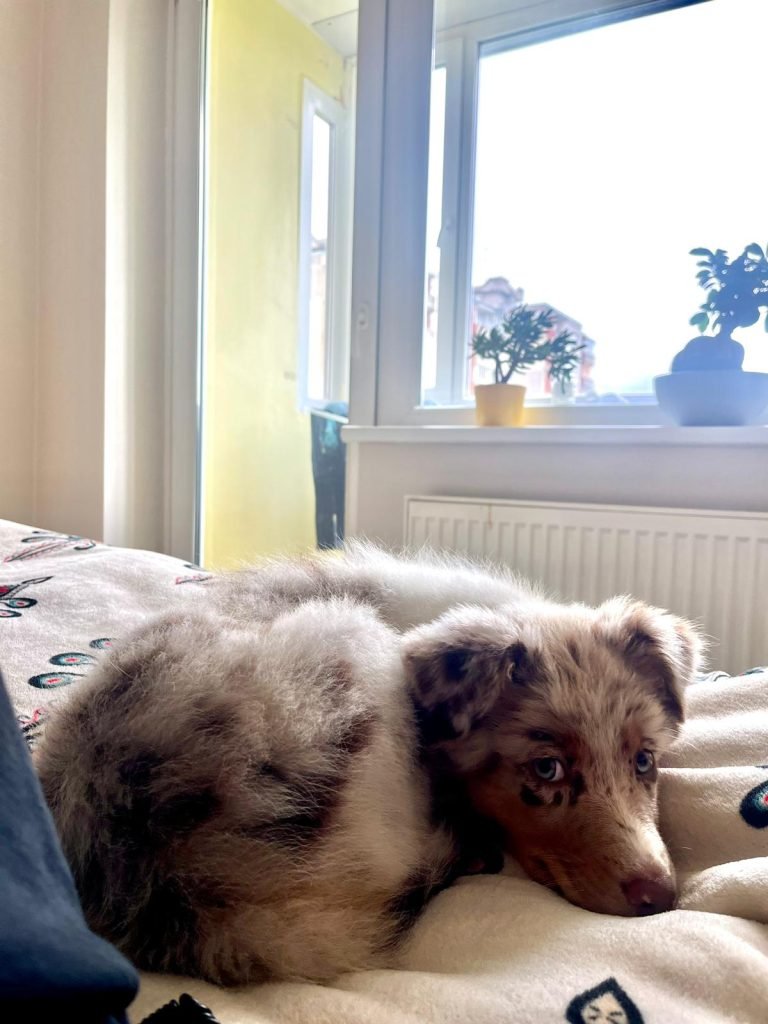
Whining: when to wait and when to help
A brief squeak, a change of position or a few seconds of complaint do not necessarily mean you must open the door at once. You can wait for a short pause of quiet and let him out calmly.
But escalating barking, thrashing about, trying to break out, heavy drooling, a sudden refusal of normally valuable food, urinating from fear or a risk of self-injury are not manipulation. This is a state of severe stress. Open the door safely, help him settle, and next time go back to a far easier step.
A puppy left to “cry it out” does not learn to feel safe. Sometimes he only learns that help will not come.
How long a dog may stay in the crate
There is no single formula that calculates a safe duration precisely from a puppy’s age in months. Physical bladder control, previous experience, the time of day and emotional state all differ.
A crate is for sleeping, for short safe periods and for specific situations — not for a whole working day followed by another night in the crate. If you will be away a long time, you need a larger safe area, a toilet solution and help from another person.
An open crate can remain a dog’s resting place for life. A closed door should be used as much as is needed, not as much as is technically possible.
How to know that crate training worked
Success is not silence alone. The dog chooses to go in himself, can eat and sleep in the crate, changes position easily, does not panic when he hears you, and when released does not burst out as though he had just been rescued.
A good crate does not make a dog’s life smaller. It gives him a safe place within it.
Read next: The first night and learning to stay alone