
These days, when a puppy barks at a passer-by, chews on hands, will not stay alone or suddenly starts being afraid of something, many of us no longer look for the answer on Google. We open ChatGPT, Claude, Gemini, Copilot or Perplexity and type: “My five-month-old puppy growls when I try to take his toy. What should I do?” A few seconds later we have a tidy, logical and usually very confidently written answer.
And this is exactly where the risk begins. Such an answer can sound so convincing that it is easy to forget one simple thing — the artificial intelligence has not seen your dog. It has not seen his body language, does not know how he has lived these past weeks, how much he has slept, what happened before that particular behaviour, or how his owner responds to it.
So tools like ChatGPT, Claude, Gemini, Copilot or Perplexity can be excellent helpers, but rather poor sole sources of truth.
Where AI genuinely helps
The problem is certainly not that AI “knows nothing”. Quite the opposite — in a few seconds it can explain what resource guarding is, why puppies bite, how desensitisation works, how fear differs from aggression, or how to start teaching a puppy to stay alone calmly. For that kind of information AI is very convenient.
The limit appears when the question turns from “explain this topic to me” into “tell me what is going on with my dog”.
The same behaviour, two opposite causes
For example, an owner writes: “In the evenings my puppy attacks my legs and bites very hard.” AI may suggest more physical and mental exercise. Sometimes that would be right. But exactly the same behaviour can mean the complete opposite — the puppy is overtired, over-stimulated and simply cannot settle in the evening.
In that case another walk or another active training session can only make things worse. Someone who knows the dog well would first ask how much he sleeps, what he did during the day, when the biting starts and what happens just before it.
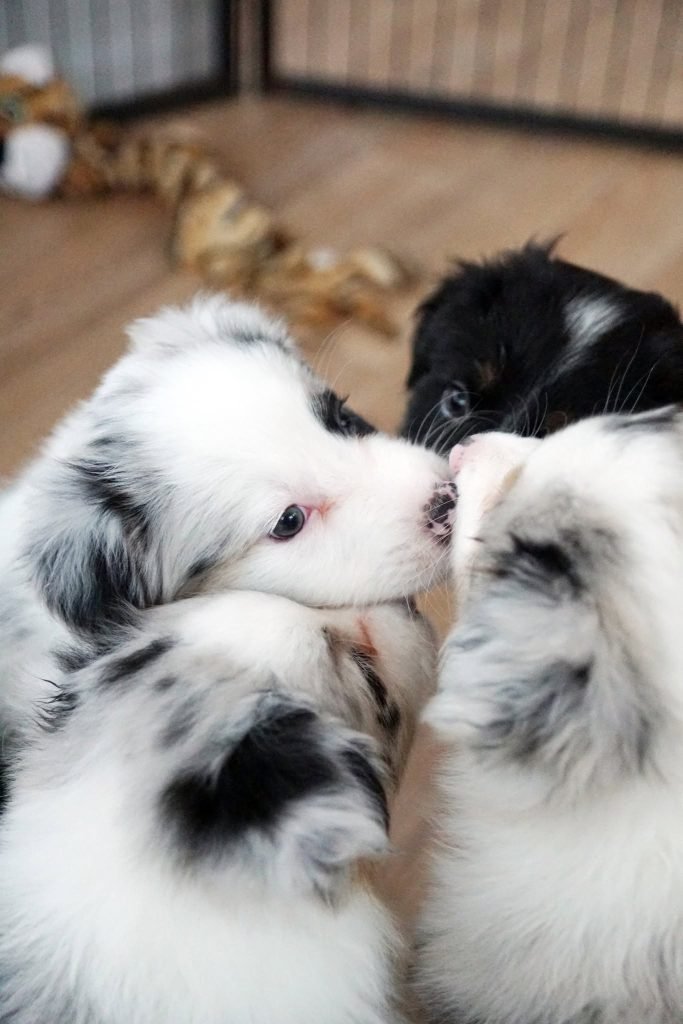
Growling is not bad behaviour. It is information
It is much the same with growling. If you write “my dog growls when I try to take his bone”, you may get a good explanation of resource guarding — but you may also get an oversimplified suggestion that the dog must learn to give things up, or that clearer boundaries are needed.
The trouble is that growling is not “bad behaviour”. It is information. The dog is saying that in a particular situation he feels unsafe. If a person starts punishing the growl or taking things away more often, the feeling of insecurity does not go anywhere. Only the warning may disappear.
Socialisation: not as much as possible, but the right amount
The same applies to socialisation. If a puppy is afraid of people, AI may suggest taking him to crowded places more often. But if the dog is already freezing, backing away, refusing treats or trying to hide, more “socialising” can become not a positive experience but even greater pressure.
Socialisation is not as many experiences as possible. It is the right experiences at the right intensity.
When the dog is left alone
Another classic situation — a dog barks when left alone. One piece of advice may be to start with very short departures and gradually lengthen the time. Another — not to come back until the dog stops barking, so as not to “reinforce the barking”. But if the real problem is separation panic, such advice can be entirely wrong.
From the single sentence “my dog barks when alone” it is impossible to tell whether he is simply protesting or experiencing severe stress. You need to see whether he can eat, whether he paces back and forth, whether he tries to escape, whether he settles after a few minutes, or whether the situation only gets worse.
Why AI sounds more confident than it should
That is precisely why AI sometimes sounds more confident than it should. It generates an answer based on what we wrote. If we did not provide important context, the model will not know it — and sometimes we will not even realise that context was needed.
AI as a library, not as a trainer
So AI is best used not as a trainer but as a very fast library. If a trainer or breeder used a term you did not understand, AI can explain it. If you want to build a behaviour diary, an observation table, a training plan, or to understand the principle behind a particular method — here it is very useful.
If the question matters, it is worth not tying yourself to a single model. The same situation can be discussed with ChatGPT, Claude, Gemini or Perplexity. If the answers differ greatly, that is often a sign not to pick the one you liked best, but to realise that the situation is missing context.
Better still — ask: “When might this advice be wrong?”, “What other causes could produce the same behaviour?” or “What information should I still gather before deciding?”
What no model can see
And this is where a person becomes valuable. A competent breeder often knows the dog from his first weeks of life, has seen his temperament, his mother, his brothers and sisters, and knows the strengths and weaknesses of their own lines. So sometimes one video or a short conversation tells them more than ten AI answers.
Of course, the mere fact that someone is a breeder does not automatically make them a behaviourist. A good breeder must also be able to say: “At this point it is better to consult a trainer, a behaviourist or a vet.”
Sometimes one good consultation gives more than fifty answers from the internet, because a specialist can notice what the owner did not even know needed mentioning. You see a dog sitting calmly; a trainer may see a frozen body, a tight jaw, weight shifted forward and a very clear readiness to react.
The answer is not “AI or a human”
So the answer is not “AI or a human”. Do use AI. It can help you grasp a topic quickly, lay out possible causes, ask better questions and prepare for a conversation with a specialist.
But when the question changes from “what could generally cause this?” to “what is going on with my dog?”, it is worth stopping and bringing in someone who can assess the whole situation.
Because the goal is not to stop unwanted behaviour as quickly as possible. The goal is to understand why it appeared.
AI can help you become a better-informed owner. But sometimes the best answer to “why does my dog do this?” is not another prompt, but a person who looks at the situation and says:
“Show me what happens just before.”